Your Career Type

One of the Voyagers, the family of careers that do one kind of work across very different environments

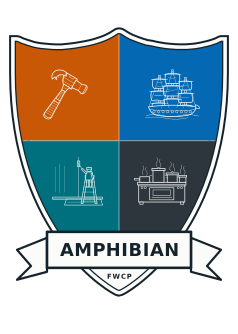
The Amphibian

One kind of work, across very different worlds, held several at a time, each done well. (FWCP)

Discover your career type

1 minute. Free. No spam.

Amphibian, FWCP
About the name

In everyday English, an amphibian is an animal such as a frog, living both on land and in water. An Amphibian career holds one kind of work, done well, in more than one very different world at the same time.

Coming soon

The Amphibian
Your best fit

Which of the sixteen types fits you?

The scan shows the career you've had. The trait test, which I'm building now, shows which of the sixteen types fits who you are, and how far your career is from that type.

What is an Amphibian career

An Amphibian (FWCP) works in several very different worlds in the same week, with the same kind of work in each, and earns a standing in every one of those worlds.

The work is the same in every post, a post being any job, practice, volunteer role or reserve commission. An Amphibian’s worlds, their work environments, differ in almost everything else, from the people and the pace to the unwritten rules and sometimes the language. An Amphibian uses the same know-how on a Monday in one world and on a Thursday in another, and learns each world’s habits from that world’s own people while already doing the work. In the lists below, a trade or a craft means any kind of skilled work, a lawyer’s or a nurse’s as much as a carpenter’s.

A lawyer advises a food manufacturer on its employment contracts and, two evenings a week, gives free advice at a charity for migrant workers. The same employment law serves both, in two worlds with different people, a different pace and a different idea of a good result.

An Amphibian does the work well, to a standard every world can trust, and keeps to that standard in every post. The rest of an Amphibian’s energy goes into running the posts side by side, into learning how each world works and into life outside work.

An Amphibian is at home in more than one world at a time. Each world gets a colleague who does the same job under very different conditions every week, and the Amphibian has more than one place where the work is wanted.


What FWCP stands for

The Amphibian's family, the Voyagers (FW)

The first two letters of a code shape a working life more than the other two. How varied the roles are and how different their environments decide what a career is like from one year to the next, so the sixteen career types are grouped by those two letters into four families.

The method behind the types. Every career type here comes from one typology, built on five aspects of a career, each running between two ends. A type is the end a career sits nearest on each.

How the typology works

FR

The Specialists

One kind of work, in similar environments

VR

The Locals

Very different work, in similar environments

FW

The Voyagers

One kind of work, across very different environments

VW

The Generalists

Very different work, across very different environments

The four Voyagers

FWCP

The Amphibian

Several commitments at once, each done well

An Amphibian career in practice

  • On a city ambulance and at sea

    A paramedic works three weeks a month on a city’s ambulances and spends the fourth week as the medic on a ship that services offshore wind turbines. On the ambulance a hospital is minutes away, and the calls come by radio. At sea the nearest hospital is a helicopter flight away, and the crew rely on the medic to keep every technician fit to climb the turbine towers. After the first winter, the ship’s owner renewed the paramedic’s contract for three more years.

  • In a television studio and on a heritage railway

    A self-employed carpenter builds sets for a television studio, where a set goes up in two days and comes down after one season of filming. The same carpenter also belongs to the volunteer crew of a heritage railway, repairing wooden carriages from drawings a century old, at the volunteers’ unhurried pace. One spring the railway’s oldest carriage carried passengers again, on a frame the carpenter had rebuilt as a volunteer.

  • In a supermarket chain and an aid agency

    A logistics manager plans the deliveries to two hundred supermarkets for a retail chain, where shelves are restocked overnight and a lorry that arrives late means empty shelves by morning. The manager also sits on an emergency aid agency’s standby roster, planning how tents and water filters reach a disaster zone where roads and customs rules change by the day. When floods struck a neighbouring country, the agency’s first lorries crossed the border within two days, on a route the manager had planned.

What kind of people are drawn to an Amphibian career?

Every career type suits some people more than others, and part of the reason lies in their traits. The test measures the traits behind each letter of the code, and these four draw people to an Amphibian career.

Read how traits point to a career type

  • Careful with the unknown

    They are less inclined to explore the unknown when it feels risky.

  • Enjoys making introductions

    They like introducing people who could benefit from knowing each other.

  • Sets goals to do well

    Their goals centre on doing well more than on learning something new.

  • Wants several things running at once

    They like having more than one project going at the same time.

What an Amphibian career gives, and what it costs

What it gives

  • Two worlds kept up for years

    Holding the same work at a standard they already have, they keep enough in reserve to learn and keep up two very different worlds at once.

  • Their trade opens the door

    In a world where nobody knows them, they are introduced by a recognisable craft that says what they can do before anyone has seen it.

  • Time on familiar ground

    Their work stays familiar, so more of their working life goes on doing it well rather than working it out.

  • Many kinds of people

    They come to know people from worlds most people do not see.

  • Rarely out on a limb

    They work within what their trade already knows works, so few of their calls rest on their own judgement alone.

  • Somewhere to turn

    When one commitment stalls, they can put their energy into another.

What it costs

  • Expected at full speed on day one

    Because the work is familiar, they are expected to perform at once in a new world whose unwritten rules they do not yet know.

  • Rarely the insider

    In each place, someone who has been there longer knows it better.

  • One of many

    Their CV looks much like everyone else’s in their trade.

  • Can plateau

    Once good enough, the work may stop offering anything to aim for.

  • New starts share their attention

    A new commitment begins beside the others, so it seldom gets their whole effort at first.

What an Amphibian career means for life outside work

An Amphibian career shapes life outside work too, from home and family to free time.

  • Practised at settling in

    Having changed worlds before, they know how to build a routine and a circle among people who work differently.

  • More than one leg to stand on

    When more than one of their commitments pays, losing one income leaves the others.

  • Fewer ways to reshape the work

    When life at home changes, they have fewer other kinds of work to turn to, since those would mean starting again.

Self-Led or Guided

Every Amphibian career sits somewhere between Self-Led and Guided, depending on where its roles came from. Most careers hold some of each, and the variant follows the moves that shaped the career most. Self-Led or Guided

The Self-Led Amphibian

FWCPO, O for owned

A Self-Led Amphibian goes looking for the second world, and often the third. A nurse applies for summer work at a children’s camp, an IT administrator answers a call for volunteers from a city’s food bank, and an accountant audits a charity’s books on Saturdays. Some Self-Led Amphibians keep a salaried post and add a second post of their own choosing, and others run a business of their own beside a volunteer or reserve post.

A Self-Led Amphibian has to fit each new post around the posts already held without help, from the rota and the leave to an employer’s rules on outside work. In a new world nobody has yet seen the Amphibian work, so the first months in that world are spent showing the standard the Amphibian already holds in the other worlds. Many employment contracts limit outside work, so written approval from the current employer, asked for before applying for a new post, saves a Self-Led Amphibian a clash later.

Matthieu Gérain, a Self-Led AmphibianMatthieu Gérain is an emergency physician at the hospital in Le Mans, in France. Straight after qualifying as a doctor, Gérain joined the medical service of an army regiment as a reserve doctor. For more than ten years Gérain has volunteered for operations abroad, and in Chad he was the only doctor for thirty French soldiers. Being a reservist, Gérain says, is practising his profession another way. A Self-Led Amphibian (FWCP-O).

The Guided Amphibian

FWCPG, G for guided

A Guided Amphibian’s second world is offered. A blood service asks a city nurse to staff its mobile donor sessions, a professional body appoints an engineer to its inspection panel, and a reserve force invites a civilian doctor, lawyer or IT administrator to bring the same skill into uniform for part of each year. The institution usually supplies what the new world asks beyond the skill, from the training to the uniform. Some posts go only to people an institution sends, from a naval ship’s sick bay to the legal office of a peacekeeping mission.

Each call from the institution also takes days from the Amphibian’s other posts. A call-up, a placement or a new task arrives when the institution needs the Amphibian, and the employers in the other posts and the Amphibian’s household have to make room. A standing arrangement with one colleague in each of the other posts, agreed before any call arrives, lets a Guided Amphibian answer a call without leaving patients or clients waiting.

Bart Damen, a Guided AmphibianBart Damen was called up before finishing his law degree and served as an infantry officer. In the year he was sworn in as a lawyer, Damen moved to the Dutch armed forces’ Military Legal Service, where he was placed as a reservist. Beside a law practice that includes military cases, Damen spent more than three months in Kunduz, Afghanistan, as a rule-of-law adviser, and chairs the Dutch armed forces’ mobile court, a reserve post. A Guided Amphibian (FWCP-G).

Real Amphibians

The judge's robe and the army beret, from Erik Berg's career

Erik Berg

Self-Led

Erik Berg is a criminal judge in The Hague, after nine years as a lawyer. Beside the legal work, Berg joined the National Reserve as a private, after seeing a leaflet at a Defence recruitment office in Hengelo. Wanting to serve abroad, Berg moved to the Dutch army’s Civil-Military Interaction Command, became an officer and went to Uruzgan, in Afghanistan, to support local judges, prosecutors and prison staff. A Self-Led Amphibian (FWCP-O).

  1. Lawyer, then criminal judge
  2. A leaflet in Hengelo
  3. Adviser to local judges in Uruzgan
The operating theatre's lamp, from Yuichi Fukumoto's career

Yuichi Fukumoto

Self-Led

Yuichi Fukumoto was deputy head nurse of the operating theatres at a hospital in Kagoshima, Japan. After the earthquake in eastern Japan, Fukumoto wanted to do more than give money and chose the Self-Defense Forces reserve, though the hospital banned side jobs. Asked for an exception, the head of nursing told Fukumoto to come back after passing the entrance exam. Passing the next spring, Fukumoto joined a Ground Self-Defense Force medical unit beside the hospital post. A Self-Led Amphibian (FWCP-O).

  1. Operating theatre nurse
  2. A word with the head of nursing
  3. Nurse and reservist in a medical unit
A laptop with a padlock on its screen, from Sille Laks's career

Sille Laks

FWCP

Sille Laks has worked in information security at CERT-EE, Estonia’s team for handling cyber incidents, and at the company Clarified Security, where she ran penetration tests, attacks on a client’s systems made with the client’s permission to find weak points, and hands-on security training. Beside the company work, Laks was a long-standing member of the Estonian Defence League’s cyber defence unit, a volunteer unit of about two hundred members that can form rapid-response teams for large incidents. An Amphibian (FWCP).

  1. Security expert at CERT-EE
  2. Penetration tester at Clarified Security
  3. Volunteer in the Defence League's cyber unit
A ship at the quay, the bollard, a church behind, from Jan Willem Ester's career

Jan Willem Ester

Self-Led

Jan Willem Ester was a minister in three Dutch congregations for twenty-seven years. When the port pastor in Moerdijk retired, Ester, a member of his church’s seafarers’ committee, took over the port pastor’s work through an interchurch foundation. Ester now works half time as minister of a Rotterdam congregation and half time as a port pastor. Ester visits ships’ crews and welcomes seafarers from all over the world at the seamen’s house in Moerdijk. A Self-Led Amphibian (FWCP-O).

  1. Minister in three congregations
  2. Taking over the port pastor's work
  3. Aboard the ships at Moerdijk
An army field ambulance, from Matthieu Gérain's career

Matthieu Gérain

Self-Led

Matthieu Gérain is an emergency physician at the hospital in Le Mans, in France. Straight after qualifying as a doctor, Gérain joined the medical service of an army regiment as a reserve doctor. For more than ten years Gérain has volunteered for operations abroad, and in Chad he was the only doctor for thirty French soldiers. Being a reservist, Gérain says, is practising his profession another way. A Self-Led Amphibian (FWCP-O).

  1. Emergency physician and regimental reservist
  2. Volunteer for operations abroad
  3. The only doctor at a post in Chad
The scales on the law books, an officer's cap, from Bart Damen's career

Bart Damen

Guided

Bart Damen was called up before finishing his law degree and served as an infantry officer. In the year he was sworn in as a lawyer, Damen moved to the Dutch armed forces’ Military Legal Service, where he was placed as a reservist. Beside a law practice that includes military cases, Damen spent more than three months in Kunduz, Afghanistan, as a rule-of-law adviser, and chairs the Dutch armed forces’ mobile court, a reserve post. A Guided Amphibian (FWCP-G).

  1. Called up before graduating
  2. Rule-of-law adviser in Kunduz
  3. Lawyer and chair of the mobile court

What an Amphibian brings to work

At work, an Amphibian (FWCP) brings into each world a view of the same job from somewhere very different.

  • Fresh eyes

    They see what people who have been there for years no longer notice.

  • Lessons that cross over

    Something that works in one of their roles can be tried in another while they still hold both.

  • Where they belong is plain

    Nobody wonders where they fit, so they are seldom asked to fill gaps outside their trade.

  • Work that fits the need

    They judge how good the work has to be, and deliver that.

The blind spot

An Amphibian knows well how one kind of work finds a place in very different worlds, such as how a nurse comes to work in a prison or at a festival as well as on a district round, and knows much less about moves into other kinds of work, such as a nurse becoming a manager or a researcher. In an appraisal or a mentoring talk, a colleague hoping to change the kind of work can get a detailed account of new worlds for the same work, which is not the advice the colleague came for.

Where Amphibian careers happen

Amphibian careers grow around work organised in shifts, seasons, standby rosters or part-time contracts, which leave room for a post in a second world. A reserve force, a staffing agency or a volunteer roster is often the way a second world first asks for the work.

  • Nursing

    A district nursing team, a prison’s health unit, a festival’s first-aid tent

  • General medicine

    A city practice, a reserve medical unit, a mountain rescue service’s doctor roster

  • Dentistry

    An orthodontic practice, a prison’s dental clinic, a mobile clinic touring remote villages

  • Chaplaincy

    A seafarers’ mission in a port, a city’s police force, an army regiment

  • Journalism

    A national newspaper’s business desk, a magazine for builders, a local radio station’s weekend news

  • IT administration

    A city council’s network, a rowing club’s booking system, a family-run campsite’s booking system

  • Interpreting

    An asylum agency’s interviews, fairs for machine makers, a football club’s new players from abroad

Other names for an Amphibian career

Other words people use for this pattern, and how each fits an Amphibian.

  • “International career”, “expat”

    Said of a career that works in more than one country. Both words fit an Amphibian whose worlds are countries, and expat only while the Amphibian lives abroad. On this site a new country counts as a new world only when the people, rules and habits of the work change with the country, so very different worlds can also lie in one city.

  • “Specialist”

    In everyday use, a person known for one kind of work is called a specialist, and the word fits an Amphibian. On this site the Specialists are the family whose careers keep one kind of work within similar environments, so the Amphibian, whose worlds differ widely, belongs to the Voyagers. FRThe Specialists

  • “Portfolio career”

    Two or more commitments kept going together. In everyday use the label usually means different kinds of work held together, which on this site points first to the Mender (VWCP), and within one world to the Keystone (VRCP). An Amphibian’s portfolio holds one kind of work in several worlds. VWCPThe Mender VRCPThe Keystone

Making an Amphibian career work

An Amphibian (FWCP) starts in a new world while still working in the others, so each arrival comes on top of a full week. The five points below make each arrival lighter, and several of the points keep paying in the steadier stretches between arrivals.

  • Sit in on the new world first

    An afternoon spent in a new world before the first working day, watching the work being done, reading the documents the world uses and hearing which mistakes newcomers make, lets an Amphibian arrive already knowing some of the habits the world expects.

  • Offer each world something from the others

    In each world, an Amphibian can offer the people who know that world best a method, a contact or a way of working seen in another world. Colleagues who have been helped tend to be quicker to explain why each rule exists and whom to see first.

  • Put the worlds on the CV

    A CV that names each world, what the world demanded and what the work achieved in it shows a hiring manager a range that a list of job titles does not.

  • Add a world that teaches something new

    When the work runs smoothly in every world, a new world with its own challenge, such as another language, a remote setting or a different kind of client, gives an Amphibian something new to learn without changing the work.

  • Hand over one task before the start

    Before a new world starts, an Amphibian can move or hand over one task in each existing post, so the new commitment gets more of the Amphibian’s attention in its first weeks, when the people in the new world are forming their first view of the work.

The skills an Amphibian career asks for

The skillFocusedWidespreadCompetenceParallel
Running several commitments

Keeping two or more posts going in one week, each with its own calendar, people and rules, without one post draining the others.

P
Serves Parallel
Learning the unwritten rules

Discovering how each world really runs, who decides and what earns trust, quickly enough to do the work well from the first weeks.

W
Serves Widespread
Knowing when to quit

Seeing the moment a world stops repaying the hours it takes, and parting on good terms, so the door stays open.

WP
Serves WidespreadServes Parallel
Keeping a wide network

Staying in touch with contacts from every world, so an introduction is ready when a colleague, or the Amphibian, needs one.

W
Serves Widespread
Translating between worlds

Putting the work into each world's own words, so that people who describe the same skill very differently understand what the Amphibian offers.

FW
Serves FocusedServes Widespread
Guarding attention

Keeping a fixed share of the week for each post, so that no post gets only what is left.

CP
Serves CompetenceServes Parallel

Where an Amphibian career comes from, and where it goes

An Amphibian (FWCP) career can begin as one kind of work held in one world, or as one kind of work moved through very different worlds in turn. Two further types sit one aspect beyond the Amphibian.

Where it often starts
Amphibian, FWCPFWCP

An Amphibian career keeps one kind of work going in several very different worlds side by side, and every one of those worlds counts the Amphibian as one of its own.

Where it can go next

Both at once, very different roles and the push for mastery, lead toward the PolymathVWMP

Has your career been an Amphibian's?

Discover your career type

1 minute. Free. No spam.

Coming soon

The Amphibian
Your best fit

Which of the sixteen types fits you?

The scan shows the career you've had. The trait test, which I'm building now, shows which of the sixteen types fits who you are, and how far your career is from that type.